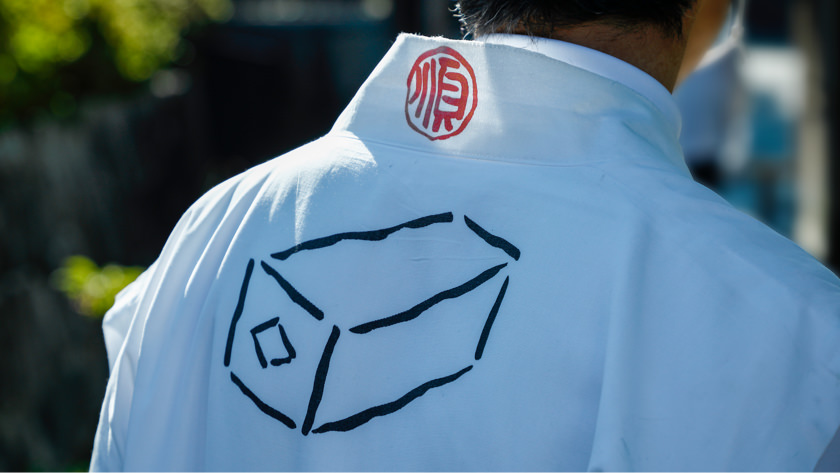
From the strongly built main gate of the restaurant, a stone pavement leads visitors to the entrance hall highlighted by the calligraphy of Sensho Manabe, the lord of the Sabae domain who once governed Kyoto as a representative of the Shogunate government.
The building that is now a Japanese restaurant was originally a medical school, established in 1839 by Ryotei Shingu (1787-1854). At this school, talented students studied anatomy, physiology, pathology,surgery, internal medicine, natural history, chemistry, and pharmacy.
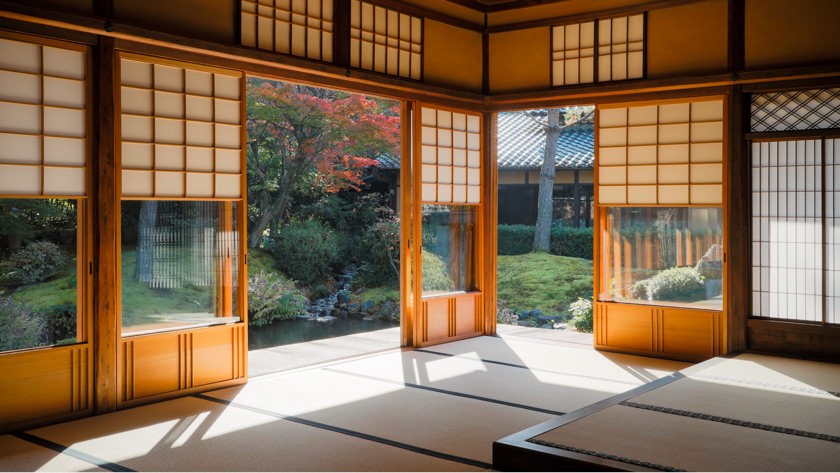
The main building with tiled and thatched roofs appears one storied, but part of the building actually comprises three stories. Featuring traditional shoin-zukuri architecture, the main building with its attached tea-ceremony room has bean designated a tangible national cultural property.
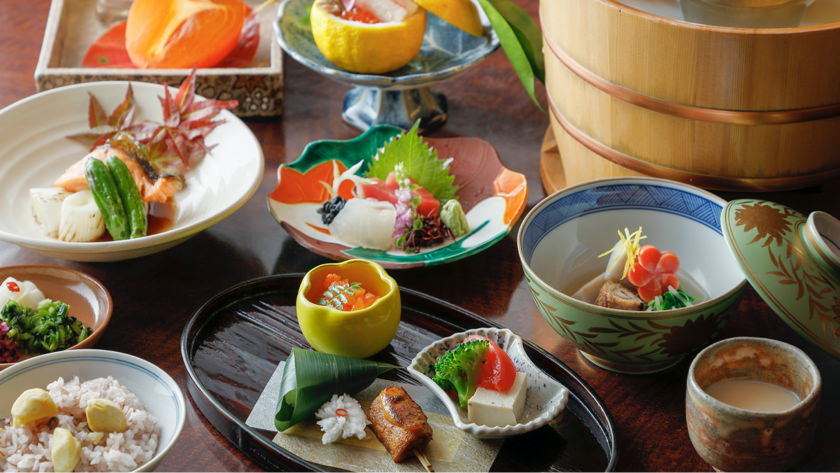
Even though Nanzenji Junsei main restaurant specializing in tofu dishes opened in this building just after World War II, the major architectural features have bean retained, including the garden and even the furniture in the room where Doctor Ryotei lectured. "In addition to a medical school, Junsei Shoin functioned as a salon where various artists and men of culture gathered," said the restaurant owner. "We still have a collection of calligraphy and paintings created by such people."
The founder of the medical school, Ryotei Shingu was born into a relatively poor family in Yura, Province of Tango (now Miyazu City, Kyoto Prefecture). After studying Chinese medical science in Edo (now Tokyo), he opened a clinic in his hometown at the age of eighteen. Later, however, he learned that Western medical science was much more precise, and so traveled to Nagasaki (Kyushu), which was the only gateway to the Western world during the period of Japan's seclusion. At that time, no Westerners except the Dutch were permitted to stay and trade in Japan; however, even they were confined in an artificial island in Nagasaki, and direct contact with the Japanese people was restricted under Japan's strict national seclusion policy. Accordingly, it was extremely fortunate that Ryotei was admitted to the Dutch trading post, and was given the opportunity to study Western medical science under a Dutch doctor. After returning from Nagasaki, Ryotei began practicing medicine in Kyoto at the age of 33. Every morning he treated about 100 patients at his home, and visited about 50 patients every afternoon. To call on as many patients as possible, Ryotei always ran from one house to the next, followed by an assistant carrying medical instruments and medicines. It did not take long before Ryotei became famous as a skilled physician. Among his clients was a rich merchant family named Konoike, who contributed a large sum of money to his work, the amount of which was sufficient for Ryotei to manage his clinic without any other source of income.
Using funds accumulated in this way, Ryotei established a medical school "Junsei Shoin." Since Ryotei had bean raised in poor circumstances and had to earn his own education expenses, he hoped to help and encourage young medical students whose family backgrounds were similar to his own. In the year of Ryotei's death, the Shogunate government abandoned its national seclusion policy, and reopened a few ports, urged by Commodore Matthew Perry, a US naval officer. In subsequent years, the entire nation saw the rapid modernization of various social systems, including educational and medical systems. Junsei Shoin had contributed greatly to the development of modern medical science in Japan, and some of Ryotei's students established the Kyoto Medical Society, which later developed into Kyoto Prefectural University of Medicine.